
Lancaster Release Estimates and Actual Dates
A projected release date is a calculation, not a promise. For a current VADOC sentence, the public locator may show an Estimated Release Date. That value reflects the information and credits in the state record when it was calculated. The actual release occurs only after staff complete required checks and the person leaves custody under an Order of Release, parole conditions, transfer order, or other controlling document. The distinction matters whenever families arrange transportation or plan a check-in.
Lancaster County pretrial custody works differently. An unsentenced detainee has no sentence end date to compute. Release may follow bond, recognizance, dismissal, a court order, or another legal event. Other cases, warrants, or detainers can still prevent community release. For that person, read the Lancaster court case and ask the jail for the actual terminal custody entry instead of estimating from an arrest date.
A transfer date is also not a community release date. If Lancaster County Jail sends someone into VADOC authority, the local custody event ends but confinement continues. The next estimate belongs to VADOC. If the destination is NNRJ, ICE, USMS, or another jail, follow the receiving authority until a terminal release is documented.
Find a Lancaster Inmate Release Date
Begin with sentence type and last custodian. Local officials calculate many local sentences, while VADOC calculates state-responsible terms. The same person can move from one system to the other. A court order supplies the legal term, but the facility computation applies jail credit, earned credit, consecutive or concurrent structure, and later changes.
- Confirm whether the person is pretrial, serving a Lancaster local sentence, or serving a VADOC state term.
- For state custody, search the VADOC Inmate and Supervisee Locator by name or seven-digit DOC number and read the record's estimated date.
- For a local term, call Lancaster County Jail at 804-462-5111 and request the facility's release calculation and written credit policy.
- Compare the calculation with the sentencing order, jail credit, amended orders, and any other active cases.
- Near the date, confirm with the holding facility and use the correct notification system for the custody type.
Do not assume a short Lancaster jail stay will appear in VADOC. The state locator covers VADOC inmates and supervisees, selected people in local or regional jails under state authority, and other defined state populations. A purely local pretrial or misdemeanor stay may have no VADOC record at all. The Lancaster Sheriff and court remain the primary route.
The full search sequence for a person who has already left custody appears on Lancaster County Released Inmates. That path adds the destination field, court authority, VINE event, and records request needed to distinguish discharge from transfer.
VADOC Lancaster Release Date Records
VADOC calls its public tool the Inmate and Supervisee Locator because it includes both institutions and community supervision. Search results can show a facility or a district-office category. A facility result means state custody continues. A community corrections result can show that physical prison custody ended while probation, parole, or post-release supervision continues.
The locator is updated daily, but VADOC warns that data can be inaccurate or out of date. Its current estimate can change after staff receive new court information or correct a calculation. For documentary proof, request the relevant VACORIS release record, Order of Release, release letter, or conditions document from VADOC rather than saving only a locator screen.
| Record clue | What it means | What it does not prove |
|---|---|---|
| Estimated Release Date | Current state sentence projection | That physical release already occurred |
| Institution location | Current VADOC custody | Release to Lancaster community |
| District office | Community supervision category | That supervision has ended |
| Parole grant report | Board approved parole | The exact facility exit time |
| Order of Release | Official authority and terms for release | Freedom from every unrelated hold unless checked |
Lancaster Local and State Calculations
Virginia splits sentence calculation by the kind and length of sentence. VADOC's Time Computation explanation separates older Good Conduct Allowance, known as GCA, from Earned Sentence Credit, known as ESC. It also identifies which state-responsible terms VADOC calculates. Local authorities remain responsible for many local jail sentences.
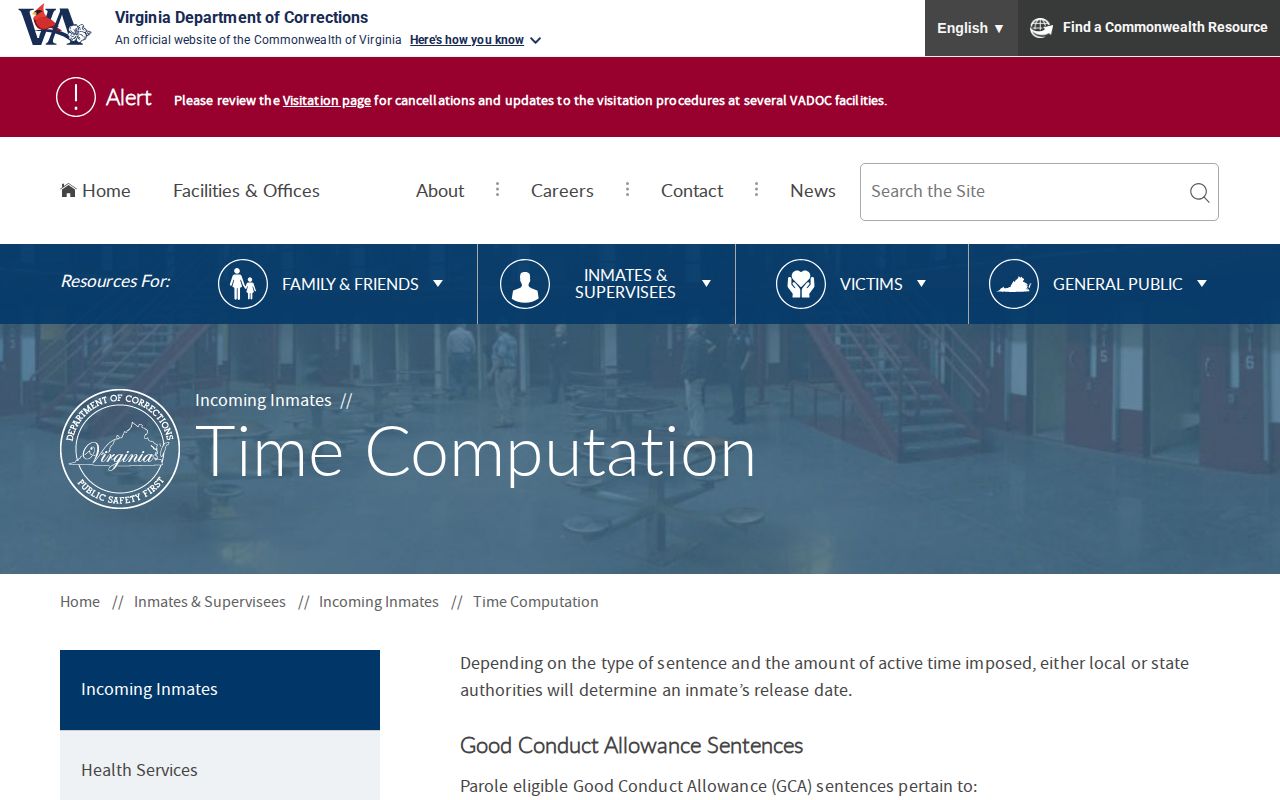
The official VADOC time-computation page shown below explains why an offense date, sentence type, active term, and credit system must be known before anyone can assess a release estimate.
For Lancaster local custody, Virginia Code § 53.1-116 requires the jailer to keep a written earned-credit policy. Lancaster's policy was not located online. That missing local document is important. Request the actual computation and policy from the jail rather than applying a statewide shortcut to a local term.
Lancaster Release Credit Policy
A person sentenced to twelve months or less for misdemeanor offenses can earn the local credit described by § 53.1-116 when the conditions apply, unless a mandatory minimum controls. The section also addresses other categories and potential program or assignment credit. Discipline can affect credit. Exact results still depend on the sentence, qualifying pretrial time, facility policy, and every open hold.
When requesting the Lancaster computation, ask for the sentence start used by the jail, all prior-custody credit, the credit class or local policy provision applied, and the resulting projected date. Also ask whether another warrant, detainer, or consecutive sentence changes the destination on that date. These fields expose the assumptions behind the total. If a court order and jail calculation conflict, obtain both records rather than choosing the date that appears earlier. The clerk can provide the signed order, while jail staff can explain which existing computation record applies to the active stay.
Note: The agency responsible for the active term should supply the calculation, because court arithmetic alone may omit credits, holds, or concurrent terms.
Virginia Credit Rules for Lancaster Releases
Older GCA sentences and newer ESC sentences are not interchangeable. VADOC generally associates GCA with felonies committed before January 1995 and misdemeanors before July 2008. When specified active GCA terms exceed twelve months, state time-computation staff calculate applicable parole, mandatory-release, and good-time dates. Rates depend on the class and controlling provisions.
ESC applies to felony offenses committed on or after January 1, 1995. Virginia Code §§ 53.1-202.2 through 202.4 govern eligibility, rates, and deductions. Current law separates enumerated ESC-1 offenses, with a maximum of 4.5 credit days for each 30 days served by class, from eligible ESC-2 offenses that can earn up to 15 days per 30. The offense and effective law decide which rule applies.
The familiar statement that a person serves at least 85 percent is only a shorthand for part of Virginia's post-1995 framework. It is not universal. Older sentences, statutory parole exceptions, ESC-2 eligibility, misdemeanors, juvenile-offense provisions, mandatory minimums, and disciplinary class can produce a different calculation. A reliable Lancaster inmate release date never begins with a universal percentage.
- GCA
- Good Conduct Allowance, an older credit and release framework tied to offense and sentence dates.
- ESC
- Earned Sentence Credit, the post-1995 felony credit system with offense-based eligibility and class rates.
- Jail credit
- Qualifying time already spent in custody that is applied to the sentence.
- Mandatory minimum
- A term that the law requires to be served without the ordinary reduction assumed for other time.
Why Lancaster Release Dates Change
A computed date can move in either direction. VADOC Operating Procedure 050.3 requires a final review of VACORIS and historical records before physical discharge. Staff check for uncalculated sentences, unsatisfied warrants, detainers, continued-custody orders, classification or disciplinary changes, and other information that affects lawful release.
| Factor | Possible effect | Best source |
|---|---|---|
| Earned-credit class or restoration | Changes credit applied to the active term | Facility computation record |
| Disciplinary loss | Can reduce earned credit and move the estimate later | VADOC or jail calculation |
| New or amended court order | Changes the term, jail credit, or sentence structure | Signed court order |
| Concurrent or consecutive sentence | Changes how multiple terms combine | Orders and time computation |
| Warrant or detainer | Can cause continued custody or transfer | Facility and receiving authority |
| Parole decision | May authorize conditional release for an eligible term | Board report plus VADOC implementation |
A detainer is a notice that another authority may seek custody. It can turn a scheduled discharge from one sentence into a handoff rather than freedom. Likewise, resolving one Lancaster case does not end another active case. Ask for the release destination whenever the final status matters.
Parole and Lancaster Release Estimates
Discretionary parole generally does not apply to Virginia felonies committed on or after January 1, 1995, but state law contains important exceptions. Older parole eligibility can depend on commitment history and statutory fractions under §§ 53.1-151, 153, and 165.1. The offense date and current version of the law must be checked before drawing a conclusion.
A Virginia Parole Board grant is not the actual release record. Certification starts planning and notices. VADOC still performs its final checks, prepares release papers, and identifies the supervising district. For a person returning to Lancaster County, the state supervision route is generally VADOC District 33 in Warsaw. Further detail appears on the Parole / Probation page.
Confirm Lancaster's Actual Release
Near a projected date, contact the office that currently holds the person. For Lancaster County Jail, ask whether the last entry is community discharge, bond, court release, or transfer. For a VADOC institution, confirm the release record and destination through VADOC. State facility guidance says discharge and parole releases occur by 11:59 p.m. on the date, weather permitting, but that state rule does not establish Lancaster County Jail's hours.
Virginia VINE can provide custody-change alerts for participating local and regional jails. State victim notifications follow a separate VADOC process. A notice should still be checked against the facility because “released or transferred” can describe a move to another custodian. An alert is timely evidence, not the signed terminal record.
Actual proof combines the release event, destination, and legal authority. If VADOC shows a prison after Lancaster reports a departure, the person transferred. If it shows District 33 and the releasing agency confirms discharge, the person is likely in the community under supervision. If all searches fail, request the last custodian's admission and release transaction.
Note: Never use an estimated date as a pickup time; confirm the event and release instructions with the facility close to the date.