
Federal Bureau of Prisons Release Scope
BOP operates the federal prison system for sentenced federal prisoners. Its public locator generally covers federal inmates from 1982 onward. A Lancaster residence, arrest, or county case does not by itself create a BOP record. There must be a federal prosecution or other documented federal custody path that brought the person into BOP responsibility.
Many federal pretrial detainees are instead held by the U.S. Marshals Service in contract or partner jails. Such a person can appear in a local or regional facility without a standard sentenced-prisoner record in the BOP locator. The federal docket, clerk, and known holding facility are then more useful than repeated BOP searches.
| Federal setting | Primary source | Meaning |
|---|---|---|
| Sentenced BOP custody | BOP locator and BOP records | National prison placement and later BOP status |
| Federal pretrial custody | Federal docket, USMS, holding jail | May never produce the expected BOP locator answer |
| Federal supervised release | Federal judgment and court records | Community status after prison, separate from BOP confinement |
| ICE custody | ICE locator and ERO | Separate immigration system, not BOP |
This custody-type check should happen before a name search. It prevents a valid federal pretrial case from being called a BOP no-match and keeps a local transfer to marshals custody from being described as release. The docket number, detention order, sentencing judgment, and register number each point to a different stage.
Search Federal Prison Release Records
The BOP Inmate Locator offers two search routes. The number search accepts a BOP register number and other listed federal identifiers, including DCDC, FBI, or INS numbers. The name search uses first, middle, and last name fields with demographic filters such as age, race, and sex. Confirm identifiers before relying on a result.
- Open the official BOP Inmate Locator.
- Use the federal register or other accepted number when available, since it narrows the match.
- Otherwise search the complete name and use demographic fields only to distinguish candidates.
- Read the location or release-status field and any displayed release date.
- Compare the result with the federal judgment and docket, especially for supervision or another detainer.
The official BOP Inmate Locator is the federal search source for sentenced BOP custody and many former federal prisoners.
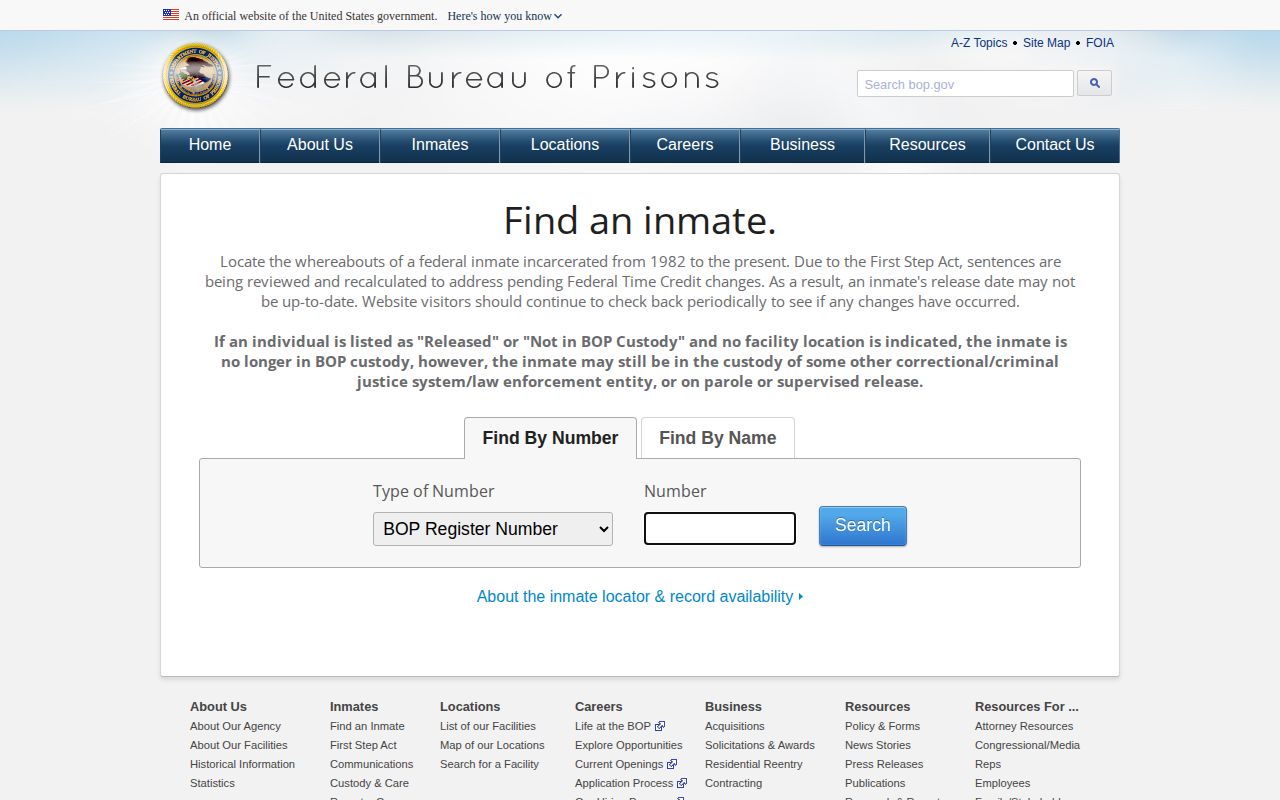
The locator can identify many former federal prisoners and display a release date, but its scope stops at BOP custody.
If the initial Lancaster County search has not yet established whether the case is local, state, or federal, begin with the Lancaster County release-record search guide. Use the BOP branch only after the evidence points to federal sentenced custody.
Reading Federal Prison Release Results
“Released” means the person is no longer held in BOP custody according to the locator record. “Not in BOP Custody” has the same narrow institutional limit. Neither phrase certifies unrestricted presence in the community. A state or local warrant, USMS matter, ICE transfer, or another lawful custody relationship may still exist.
A displayed release date also should be checked against the federal judgment and current docket when exact timing or legal status matters. Dates can change or become stale. The judgment can show a term of supervised release that begins after imprisonment, while later docket entries can document revocation or another order.
Read identity fields with the same care as status. A similar name is not enough to connect a national record to a Lancaster person. A register number, date or age, and case details should agree. If they do not, return to the federal docket instead of using the first apparent match.
| BOP number or accepted identifier | Helps distinguish the correct federal record. |
|---|---|
| Facility or location | Indicates current BOP placement when one is shown. |
| Released status | Shows that BOP custody ended, subject to locator limits. |
| Release date | Provides the federal system’s recorded date for many former prisoners. |
| Federal judgment | Explains sentence and supervised-release terms beyond the locator. |
Where Federal Prison Releases Go
A person can leave a BOP institution for the community and begin a federal supervised-release term. The federal judgment sets that term, and the federal court retains the case record. Supervised release is not the same as continued imprisonment, but it is an ongoing legal status that the simple BOP result does not fully describe.
A person may also leave BOP custody because another authority assumes custody. If a detainer or warrant is executed, the receiving agency becomes the next source. A transfer to ICE, USMS, a state department of corrections, or a local jail is not community release even though the BOP locator no longer shows confinement.
Release to the community can still leave important federal records. The judgment sets the supervised-release term and conditions, while later court entries may show modification, violation proceedings, or completion. Those court events should not be confused with the earlier date on which BOP imprisonment ended.
For a Lancaster connection, trace the custody chain through the record that names the handoff. A Lancaster County Jail entry saying transfer to federal authorities documents departure from the county building. It does not prove admission to a BOP prison, because USMS often manages the federal pretrial stage.
Federal Prison Release Records
The locator is designed for public identification and status, not for a full release packet. For deeper confirmation, use the federal judgment and docket for the sentence and later orders. A BOP FOIA request may be appropriate for agency records, but protected former-inmate material can require detailed identity information and authorization.
Frame the request around an existing document or transaction. Useful terms include the BOP register number, institution, narrow date range, release date or transfer entry, and destination where recorded. Avoid asking an agency to create a narrative that combines court, prison, marshals, and immigration records.
Federal Bureau of Prisons
Use the national inmate locator for public status.
Use BOP FOIA for eligible agency records.
Federal Court Record
Use the federal docket and clerk for the judgment, sentence, supervised-release term, and later orders.
The court record does not replace the institution’s physical release transaction.
The agency that made the last custody event should receive the first records inquiry. BOP handles the state of BOP confinement; a partner jail handles its local custody records; USMS handles marshals custody records; ICE handles immigration custody. Separating these custodians avoids an incomplete answer.
If BOP says a protected former-inmate record needs authorization, follow the agency’s identity process rather than asking an unrelated jail to supply it. Public locator fields, releasable agency records, and court documents have different access rules. A focused request is more likely to identify the precise release or transfer transaction than a demand for an entire file.
Federal Prison and USMS Custody
The U.S. Marshals Service prisoner guidance does not provide an equivalent public released-person locator. USMS may place federal pretrial detainees in contract or partner facilities, including local or regional jails. A BOP no-result can therefore be expected in some valid federal cases and is not proof that the person has been released.
Use the federal docket to identify the stage of the case and any detention or release order. Then contact the known holding facility or pursue a focused USMS or Department of Justice inquiry. A court release order supplies legal authority, while the holding facility or marshals record resolves when the person physically departed and whether another hold applied.
A partner jail’s public roster, if one exists, is still only a current-custody tool. Absence may mean transfer, release, lag, or a search mismatch. Request the partner facility’s terminal transaction and compare it with the marshals or court record before stating the outcome.
Note: Official USMS policy is restrictive on prisoner photographs, so a federal custody inquiry should not promise a publicly available booking image.
Federal Prison Release Search Limits
No BOP prison was identified within Lancaster County. Do not invent a local federal facility, and do not infer BOP custody merely from a federal interest in a county arrest. Facility identity follows the actual federal case, sentence, designation, and transfers.
A name search can miss because of spelling, an older record outside the locator’s general coverage, a pretrial USMS placement, or a mismatch in identifiers. Recheck the register number and federal docket. If a county record names ICE rather than BOP, use the separate immigration path.
BOP records and the federal docket can also disagree in apparent timing because they describe different acts. The court imposes or changes legal authority; BOP records institutional movement and release. Note the source and date for each statement instead of forcing both into one unexplained status.
The final statement should remain bounded: BOP records show the person released from BOP custody on the displayed date, or the locator does not currently place the person in BOP custody. Any claim about full community freedom requires checking the docket and every named receiving authority.